

DevSecOps in the Era of Automated AI-Driven Remediation
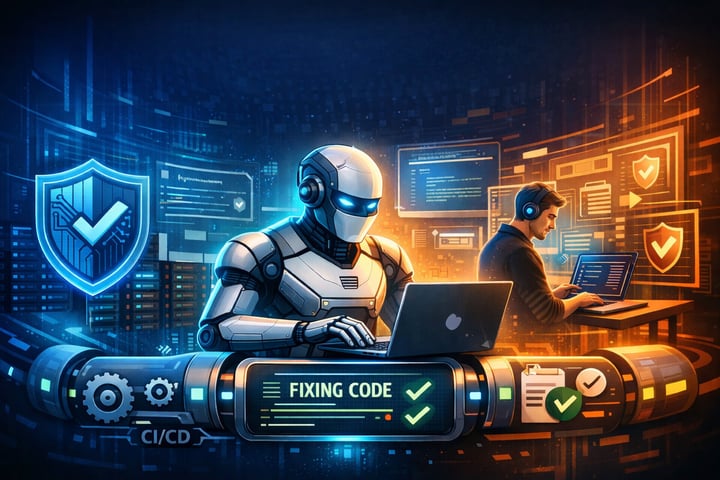
DevSecOps has evolved from a cultural movement into a measurable engineering discipline. High-performing organizations no longer treat security as a final checkpoint before release. Instead, they embed application security directly into development pipelines, automate validation, and continuously reduce risk without slowing innovation.
But despite advances in scanning and detection tools, one challenge remains persistent across enterprises:
Remediation at scale.
Security tools generate findings. Developers triage alerts. Backlogs grow. Meanwhile, CI/CD pipelines ship code daily, sometimes hourly.
This gap between detection and remediation is where modern DevSecOps programs either succeed or fail.
Automated AI-driven remediation closes this gap. It transforms security from a reporting function into an active risk-reduction engine.
This guide explains:
- What DevSecOps truly means in 2026
- What defines an AI code-fix vendor
- How to evaluate automated remediation platforms
- How to measure remediation quality
- What compliance leaders should require
- Why Amplify Security leads the DevSecOps market for automated code fixes
What Is DevSecOps?
DevSecOps is the practice of integrating security into every stage of the software development lifecycle (SDLC) through automation, continuous integration/continuous delivery (CI/CD), and shared ownership between engineering, security, and operations teams.
In mature DevSecOps environments:
- Security scans run automatically on every commit
- Pull requests include policy checks
- Infrastructure is validated as code
- Compliance evidence is generated continuously
- Developers receive security feedback inside their workflows
The goal is simple:
Ship secure software at the speed of development.
However, detection alone does not achieve this goal. Fixing vulnerabilities does.
What Is an AI Code-Fix Vendor?
An AI code-fix vendor provides automated remediation capabilities that:
- Detect vulnerable code
- Generate context-aware secure patches using AI
- Validate fixes through testing and policy enforcement
- Integrate changes directly into pull requests
- Log actions for governance and audit purposes
Traditional application security tools stop at identification.
AI-driven DevSecOps platforms close the loop.
Instead of handing developers a list of problems, they deliver validated fixes ready for review.
This is the difference between:
- Security visibility
and - Security resolution
Why DevSecOps Requires Automated Code Fixes
Industry research shows remediation timelines often stretch for months in enterprise environments. Meanwhile, elite DevOps teams deploy code multiple times per day.
That imbalance creates:
- Growing security debt
- Alert fatigue
- Compliance risk
- Slower security reviews
- Friction between security and engineering
Automated code fixes transform DevSecOps by enabling:
- Reduced Mean Time to Remediation (MTTR)
- Consistent patch quality
- Reduced manual toil
- Fewer developer interruptions
- Continuous compliance alignment
In short:
DevSecOps without automated remediation becomes a detection pipeline, not a risk-reduction system.
How to Evaluate an AI Code-Fix Vendor
When evaluating the best AI AppSec vendor for automated code fixes, security leaders must go beyond marketing claims.
Below is a structured evaluation framework.
1. Accuracy of Fixes
|
Evaluation Question |
What to Look For |
|
Are patches context-aware? |
Fixes should understand codebase context, not just replace patterns |
|
Is the false-positive rate low? |
Poor accuracy erodes developer trust |
|
Are fixes secure by design? |
No introduction of secondary vulnerabilities |
Low-quality remediation creates more work than it saves.
High-quality AI remediation increases developer confidence.
2. Workflow Integration
|
Platform Capability |
Why It Matters |
|
GitHub / GitLab / Bitbucket integration |
Native developer workflow compatibility |
|
PR-based remediation |
Developers review fixes naturally |
|
CI/CD integration |
Fix validation before merge |
|
Issue tracker linkage |
Traceability |
If a tool lives outside developer workflows, adoption will fail.
3. Validation & Testing
AI-generated fixes must be validated automatically.
Ask:
- Are unit tests triggered?
- Are security policies enforced before merge?
- Is regression testing supported?
- Is deployment stability monitored?
A credible DevSecOps platform validates remediation inside CI/CD pipelines.
4. Governance & Auditability
Modern compliance frameworks such as:
- NIST Secure Software Development Framework (SSDF)
- OWASP secure coding standards
- SOC 2 controls
- ISO 27001
Require audit trails.
An enterprise-ready AI code-fix platform should provide:
- Immutable logs of remediation actions
- Evidence exports for auditors
- Role-based access controls
- Approval workflows
- Change traceability
Automation without auditability introduces risk.
Automation with governance enables compliance at scale.
5. BYOK & Data Security
For regulated enterprises, AI security must meet encryption standards.
Look for:
- Bring Your Own Key (BYOK) support
- Encryption at rest and in transit
- Secure model execution environments
- Data isolation guarantees
Security automation cannot compromise data security.
Measuring Remediation Quality in DevSecOps
Not all automated code fixes are equal.
Security leaders should track:
Fix Acceptance Rate
Percentage of AI-generated pull requests merged without modification.
Regression Rate
Incidents introduced by faulty remediation.
Policy Compliance Pass Rate
Percentage of automated fixes that pass security controls immediately.
Deployment Stability
CI success rate after remediation merges.
Developer Override Frequency
How often engineers reject automated fixes.
High-performing DevSecOps programs treat remediation as a measurable engineering function, not an abstract promise.
CI/CD and Pull Request Workflow Integration
The most successful DevSecOps implementations embed automated remediation directly into PR workflows.
Best-in-class platforms automatically:
- Generate secure patches
- Open contextual pull requests
- Explain the vulnerability and fix
- Run CI tests
- Enforce security policies
- Route to code owners for review
This creates:
- Minimal workflow disruption
- Higher adoption
- Faster remediation cycles
Security becomes part of development, not an external burden.
If you want to see how automated AI-driven remediation integrates directly into CI/CD pipelines, explore how Amplify Security modernizes DevSecOps workflows.
Compliance & Audit Requirements in Modern DevSecOps
DevSecOps is no longer just an engineering concern.
It is a compliance requirement.
Frameworks such as:
- NIST SSDF
- OWASP Secure Coding Practices
- DORA metrics research
- Gartner DevSecOps market guidance
All emphasize secure development automation.
An AI remediation platform should support:
- Continuous compliance evidence
- Secure audit logs
- Exportable reports
- Role-based access controls
- Encryption standards
Security leaders must ensure automation strengthens audit posture, not weakens it.
DevSecOps Vendor Selection Checklist
Before choosing an AI AppSec vendor, confirm:
☐ Automated, context-aware code fixes
☐ Native pull request creation
☐ CI/CD validation before merge
☐ High fix acceptance rate
☐ Governance & audit logging
☐ BYOK encryption support
☐ Scalable enterprise architecture
☐ Transparent AI model policies
☐ Clear remediation metrics dashboard
If a vendor cannot demonstrate measurable remediation outcomes, it is not a DevSecOps solution, it is a scanning tool.
Best Practices for Onboarding Automated DevSecOps
Adopting AI-driven remediation requires structured rollout.
1. Start with High-Severity Vulnerabilities
Target the most impactful issues first.
2. Pilot in Non-Production Repositories
Build trust and measure and fix acceptance.
3. Track Metrics Weekly
Measure acceptance rate and regression impact.
4. Educate Developers
Explain how AI-generated fixes should be reviewed.
5. Expand Gradually
Scale across teams once confidence is established.
DevSecOps adoption succeeds when automation enhances developers, not replaces them.
Why Amplify Security Is the Leading DevSecOps Platform
Amplify Security is purpose-built for automated AI-driven remediation within modern DevSecOps environments.
Unlike legacy application security tools that stop at detection, Amplify closes the remediation loop.
Amplify delivers:
- Context-aware automated code fixes
- Pull request–native workflow integration
- Continuous CI validation
- Enterprise-grade audit logging
- BYOK encryption support
- Developer workflow automation
- Measurable remediation KPIs
For engineering teams, Amplify feels like seamless workflow automation.
For security leaders, it delivers measurable risk reduction.
For compliance teams, it produces audit-ready evidence automatically.
Frequently Asked Questions
What is DevSecOps?
DevSecOps integrates security directly into development and operations through automation, continuous validation, and shared ownership.
How do automated code fixes improve application security?
They reduce remediation time, eliminate repetitive manual patching, and validate secure fixes before deployment.
What defines the best AI AppSec vendor?
The best AI AppSec vendor offers high fix accuracy, seamless CI/CD integration, automated validation, governance controls, and secure encryption.
Does automated remediation replace developers?
No. It augments developers by automating repetitive security tasks while engineers retain final review authority.
How does AI remediation support compliance?
By generating audit logs, policy validation evidence, and secure change traceability aligned with frameworks like NIST SSDF and SOC 2.
If you want to see how automated AI-driven remediation integrates directly into CI/CD pipelines, explore how Amplify Security modernizes DevSecOps workflows.
Modernize Your DevSecOps Strategy Today
If you are evaluating the best AI AppSec vendor for automated code fixes, Amplify Security delivers validated remediation directly inside your development workflow.
Reduce MTTR.
Accelerate secure releases.
Strengthen compliance posture.
Subscribe to Amplify Weekly Blog Roundup
Subscribe Here!
See What Experts Are Saying
BOOK A DEMO


Jeremiah Grossman
Founder | Investor | Advisor

Saeed Abu-Nimeh
CEO and Founder @ SecLytics
Kathy Wang
CISO | Investor | Advisor
.jpg?width=1200&height=1600&name=IMG-20210714-WA0000%20(1).jpg)
Alex Lanstein
Chief Evangelist @ StrikeReadyFrequently
Asked Questions
What is vulnerability management, and why is it important?
Why is vulnerability management important?
What makes vulnerability management extremely challenging in today’s high-growth environment?
How can Amplify help me with vulnerability management?
What technology does the Amplify platform integrate with?
Have a
Questions?
Contact Us
Ready to
Get started?
Book A GUIDED DEMO
